Property Management Software is All About Seamlessly Managing Properties By Riddhiman Roy, Technical Content Writer at Selecthub

The traditional approach of recording accounting transactions, inspection notes and tenant requests on papers, emails and spreadsheets can get exhaustive and overwhelming. Luckily, property management software is there to rescue you. It enables real estate professionals and landlords to automate processes, streamline workflows and control their day-to-day operations to sustain themselves in a highly competitive and ever-growing market.
With several products and tools available in the market for landlords, finding a suitable solution can be a time-consuming and daunting task. To make your selection process easier, we have created this guide to act as a starting point for your research. You will learn about the benefits, features, industry trends, price considerations and some of the top products in the market that can help you make empowered software decisions.
Executive Summary
- Property management software helps manage properties' operations, maintenance, marketing and leasing.
- The online tenant portal ensures timely rent payments by tenants, increasing the property’s ROI.
- Marketing tools and built-in screening help engage more quality applicants and expand the business.
- You can define rules to automate bookkeeping and ensure accounting accuracy across all fronts.
- Property management software selection is integral to a business’s success, and you should do it carefully.
- It’s crucial to prepare a software comparison strategy and personalized budget before starting the selection process.
How Does Property Management Software Work?
Now you may say — Sonny, it sounds great, but how can you manage such diverse workflows from a single platform? To make it easier to understand, let’s look at how property management solutions affect a typical customer’s journey from being a prospect to applying for tenancies and any subsequent lease renewals or terminations.
- You can design branded property websites and distribute ads on multiple sales channels.
- If a prospect is interested in the property, they can use the website’s portal to submit their applications.
- The system centralizes applications arriving from the website and third-party channels. Most platforms offer built-in connections with TransUnion or other credit rating agencies to allow you to screen tenants without leaving the software’s interface.
- Once you’ve identified ideal tenants, you can design eLeases using an up-to-date template library with the latest lease accounting standards.
- After guests move in, they receive unique tenant portals or mobile apps to pay rent, request maintenance, view leases and interact with landlords and managers.
- The system records every maintenance request and activity to promote accountability and streamline audit processes. Advanced solutions also let you onboard maintenance vendors and track their work progress in real time.
- The system connects with your bank account or payment gateway to instantly deposit rent, utility bills and other revenue.
- Use the reporting suite to automate periodical reporting on profitability, utility consumption, rent analysis and owner statements. You can easily design public disclosures like 1099 forms with a few clicks.
- It records all property-related financial transactions, maintains separate ledgers and organizes accounting processes.
- Lastly, the platform alerts you about every important event, including audits, lease renewals/terminations, late rent payments and maintenance activities.
Types of Property Management Software
According to psychologist Abraham Maslow’s hierarchy of needs, shelter is one of the basic needs necessary for human beings to survive. Today, real estate isn’t a luxury but a necessity as it touches every part of our lives. From schools, gyms and offices to hotels, governments and churches — all use real estate to conduct their operations.
Due to the variety of properties, it’s counterintuitive to use legacy software to manage each type. There are different categories of property management software based on the type and size of your real estate. The major ones are:
-
Residential Rental Property Management: As the name suggests, these solutions help you market, manage and maintain residential properties like houses, condos and apartments. Its features include vacancy marketing, screening, tenant management, maintenance modules and reporting.
- Commercial Property Management: Commercial properties are real estate rented to businesses and organizations instead of residents. A few examples are shopping malls, offices, government buildings and airports. Specialized modules help screen a business’s financial health, track common area maintenance (CAM), manage commercial leases and charge utility bills based on consumption.
-
HOA Software: The fundamental goal of a homeowner’s association is to build a peaceful and connected community. This software streamlines communications between residents and serves as a platform to host events, meetings and elections. Board members can create personalized covenants, conditions and restrictions (CC&R) documents and track violations.
- Landlord Software: These cloud-based platforms serve small businesses and individual landlords. You don’t require in-depth technical knowledge to implement and run the solution. They offer intuitive interfaces and simple features to simplify a landlord’s day-to-day life while offering stellar tenant experiences.
-
Hotel Management: You can market your rooms on multiple OTA, ILS and GDS to improve occupancy rates. A native booking engine allows you to take direct bookings and bypass third-party booking commissions. Digitize every front desk activity, including check-ins, checkouts, housekeeping, payments and guest messaging.
-
Self-storage Software: It helps you track a storage unit’s occupancy, maintenance and profitability. Interactive facility maps let you assign maintenance activities, authorize access and schedule payments. You can integrate the software with biometric locks, thermostats and on-premise CCTVs.
-
Lease Accounting: Those in the property management sector know that lease accounting can be tricky, especially with recent FASB ASC 842 and IASB IFRS 16 accounting standard updates. Thankfully, lease accounting solutions can automatically comply with these standards and serve as a central repository for all your leasing data.
- Property Management Apps: These are a great addition to a property manager’s toolkit as they allow you to stay on top of every operation from any remote location. Some apps serve specific functions like tenant communication, maintenance tracking and property accounting. Others are all-in-one apps that let you manage the entire property management spectrum from a mobile screen.
- Real Estate Investment: Big enterprises and private equity firms can get an in-depth view of their portfolio’s health and optimize investments.
Deployment Methods
Based on your business priorities, you can choose suitable software from either on-premise or cloud-based deployment models to seamlessly run your daily operations.
On-premise or Server-based
On-premise property management software requires a dedicated server to host the solution, with a heavy upfront hardware investment. You may need skilled IT professionals to implement, maintain and upgrade systems. Due to on-site hosting, these solutions provide in-office, limited access to your data.
These setups offer certain advantages that companies may find beneficial, such as high customization capabilities, independent of internet connection and cost-efficiency in the long run.
Cloud-based
Property management software available as SaaS, also known as online property management software, are economical options that don’t require robust hardware and IT infrastructure as vendors host the software on their native servers. The cloud facilitates online data storage and processing, enabling remote access from any location.
With a monthly subscription fee, low upfront cost and a robust internet provider, these solutions deliver benefits like minimized costs, automatic backups, greater accessibility and scalability.
These deployment strategies come with different pros and cons. Your unique business needs and requirements can guide your final choice of property management software.
Primary Benefits
Simplified Management
Performing similar tasks over and over again leads to time wastage and low productivity levels. Fortunately, automatic processes like invoice reminders, welcome emails and more can save time for other critical work like addressing customer needs and connecting with potential clients. You can set late fee reminders for renters and schedule notifications for circulating important information.
Easy Rent Collection
Manually collecting payments and chasing down tenants can be difficult and time-consuming. Mobile access and automated reminders can ensure timely payments. A convenient way of paying rent adds up to customer satisfaction. You can also automate late fee calculations through additional functionalities like late-fee calculators.
Streamlined Marketing Campaigns
It’s easier to find new tenants when people are aware of your vacancies. Property management software allows you to market your property details on personal websites, social media and third-party channels. It helps you reach a broad audience to find ideal tenants for your property quickly.
Increased Accuracy and Productivity
Handling large volumes of data is cumbersome and prone to manual errors. Automatically updated data minimizes administration work and, as a result, improves accuracy. Reducing time spent on redundant processes boosts overall productivity and leaves more space for other essential work like validating and analyzing numbers.
Improved Tenant Experiences
The baby boomer generation no longer dominates the homebuyers' market. A study found that older millennials make up 25% of the U.S. homebuyers’ population, taking the largest share among all generations. But have you ever wondered what attracts them to buy or rent a home?
Online payments, communications, maintenance requests, utility billing and rental listings are the top technologies renters want in 2022. Reliable property management software offers all these technologies and helps make your property attractive to a wide section of buyers.
Implementation Goals
Before integrating property management software, you need to recognize the fundamental goals you wish to achieve with the new platform. Here are a set of implementation goals you can accomplish with the right solution:
| Goal 1 Expand Businesses | In-built tools like marketing, advertising and tenant screening attract more applicants. Posting vacancies on popular sites and adding a customer review section can help you gain reliability in the market and grow your business. |
| Goal 2 Improve Communication | Communication between landlords and tenants is crucial to maintaining healthy relationships and increasing customer satisfaction. Regular notifications about due rent, late fees, updates on maintenance requests, signing leases and more bring real-time transparency and improve communication. |
| Goal 3 Manage Finances and Increase Revenue | Offers robust business intelligence capabilities to drive value from your operating budget and analyze financial metrics, such as income, expenditure and maintenance. Reporting and analytics tools can provide insights into improvements required to upgrade your business and maximize ROI. |
| Goal 4 Mobility and Scalability | Files stored on the cloud provide easy access to data from anywhere. Automation can help you save time to focus on investment and management activities that boost profitability. Additionally, a cloud-based platform scales with your business and allows you to handle multiple properties with regular updates and innovative functionalities. |
Basic Features & Functionality
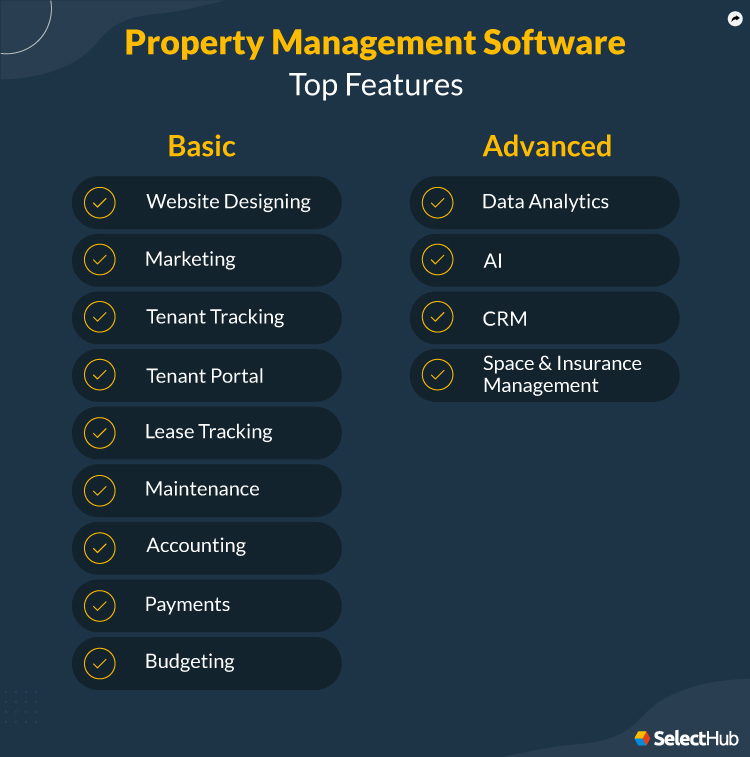
While property management software comes in varied forms, you can expect a few standard features in most of them. However, the proficiency levels of these functionalities may differ. Choose your solution wisely after evaluating the set of features that you require to fulfill your unique requirements.
| Website Designing | You can use customizable templates to design branded websites and advertise your portfolio. Advanced solutions offer WYSIWYG website editors that allow you to personalize the website design, text blocks and images. You can publish interactive 3D floor maps on the website and conduct virtual tours. |
| Marketing | Using multiple channels to market your properties can be challenging. Streamline the process by centralizing listings from every channel on a unified dashboard. You can edit and make changes to listings and auto-sync information on every channel. This helps avoid manual errors like double and overbooking. |
| Tenant Tracking | It allows landlords to track tenant data and details such as contact information, rent payments and schedules, assigned properties and payment history. Some solutions also include tenant screening tools to verify applicants’ identities and choose those who can meet payment terms and maintain the property condition. |
| Tenant Portal | A convenient online platform to help tenants pay rent and fees, submit work orders and view lease records. Residents can stay updated about due rent dates and essential information from managers. It also facilitates seamless communication between residents and landlords or office staff. |
| Lease Tracking | Track information about all lease agreements and manage contracts by keeping track of lease start and end dates, renewal window and other relevant information. You can also automate leasing procedures from prospect to move-out. |
| Maintenance Management | Property managers can utilize this feature to maintain buildings and utilities properly to deliver value and a comfortable environment to customers. Landlords can conveniently handle maintenance requests raised by tenants and accordingly assign these requests to the staff to ensure smooth functioning and tenant satisfaction. |
| Accounting | This feature helps record payments, cash flows and rental transactions through a general ledger and dashboards. You can utilize this data to create reports, get a holistic view of your properties’ financial health and discover significant trends. |
| Payment Processing | A few solutions offer native payment processors that connect to your bank account and instantly deposit rent and other revenue in return for a processing fee. Other systems integrate with popular payment gateways like PayPal and Stripe to manage digital payments. |
| Budgeting and Forecasting | Gain a centralized view of all finances and historical lease data to generate projections and forecast future costs and values. It also provides complete details about the consumer price index (CPI), market rates, changes and inflation. |
Advanced Features & Functionality
| Data Analytics | Data is one of the most crucial elements of any business and largely contributes to its success. You can make accurate, data-driven decisions through a comprehensive analysis of stored data. Using these business insights, you can identify inefficiencies and uncover new opportunities and potentials. Advanced property management software leverages data analytics to help companies develop effective marketing strategies and focus on their target demographics. |
| Data Security | Keeping your customer’s data safe is extremely important to prevent financial loss, consumer confidence disintegration and reputation damage. It can help property managers to safeguard customer’s personal and organizational data. Advanced solutions offer data encryption for increased security. |
| Artificial Intelligence | Use AI as a leasing assistant to answer prospect queries and direct them through the leasing process. It also helps read invoices, identify critical information, auto-populate forms, and automate bill receivables and payables. You can analyze your operational data and get growth opportunities and insights. |
| CRM | Most solutions store tenant information like leases, contact information, identity proof and preferences. Advanced systems can maintain profiles for every prospect visiting your website and let you identify trends by analyzing guest data. |
| Space and Insurance Management | It allocates resources and supervises material and space usage for efficient management of physical properties. You can also maintain compliance and get access to adequate insurance policies. |
Current & Upcoming Trends
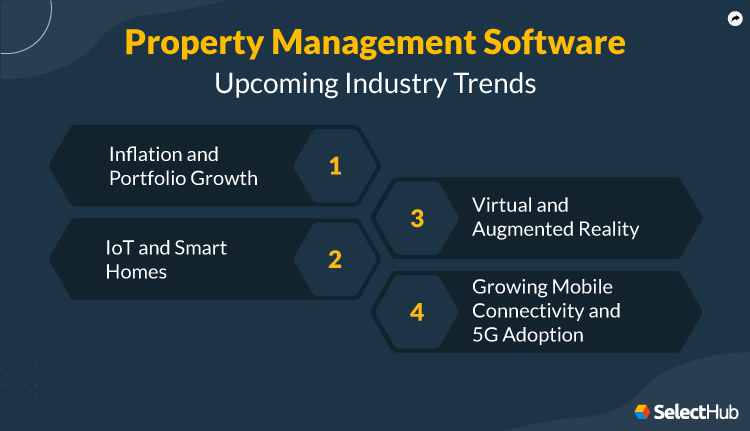
It’s necessary to evolve with modern and sophisticated technologies to survive in a highly competitive environment. To keep up with advancements, businesses must grow according to the latest changes and trends. In this section, we’ve listed some industry trends in the property management software market to help you gain a competitive advantage.
Inflation and Portfolio Growth
Economic concerns take priority in most industries, and property management is no different. A Deloitte study reveals that property managers and stakeholders have mixed revenue expectations for 2023 — 48% of surveyors expect revenue to decrease, 12% see no change, and the rest 40% are optimistic about revenue growth.
But the light at the end of the tunnel is closer than it appears. Reports suggest that inflation is peaking, leading to a drop in home prices that can reach pre-pandemic levels by mid-2023. Property managers are looking to capitalize on this opportunity by aggressively expanding their portfolios.
According to a report by Buildium, 92% of businesses plan to add new properties to their portfolio, 77% plan on expanding it by adding new owners and properties, and 50% are looking to support their current growth as an expansion strategy.
The same Buildium report found that the top priorities for managers in 2023 are growth, efficiency and profitability.
This shift in the plan represents a state of normalcy that we haven’t witnessed since the pandemic began because organizations primarily focused on owner and renter issues. Therefore, as inflation cools down, growth for property management businesses can come more easily compared to the last two years.
IoT and Smart Homes
The Internet of Things (IoT) enables landlords and managers to track a property’s usage and utility consumption. They also create a well-connected living space with intelligent automation for renters, commonly called smart homes.
The global IoT market is expected to grow from $478.36 billion in 2022 to $2,465.26 billion at a 26.4% CAGR. Also, the smart homes penetration rate is forecasted to be 21.1% by 2025. With this growth, you can expect increased adoption across different real estate segments, with a special focus on smart appliances, security and connectivity.
Virtual Reality and Augmented Reality
A report found that 95% of buyers use the internet to search for homes. Virtual reality and augmented reality can play a considerable role in making this online search and home buying experience more fascinating and accessible.
Potential buyers who can’t physically visit sites can get virtual property tours anywhere, anytime, to understand and experience the property. Augmented reality enables realtors and builders to display unfinished areas with virtual furnishings and accessories to give buyers granular insights into physical spaces and high-quality immersive experiences.
Growing Mobile Connectivity and 5G Adoption
The global 5G market is expected to grow from $58.8 billion in 2022 to $1.67 trillion by 2030 at a staggering 51.9% CAGR. With the advent of 5G, global mobile connectivity has enhanced further to gain more importance.
This increasing 5G adoption will provide higher bandwidth, allowing more smart devices to connect to the internet, create wireless workplaces, increase telecommunication and enhance digital workflows. It’ll enforce various technological innovations to promote sustainable maintenance and intelligent data insights to upgrade the quality of life. Also, you can boost home security by connecting multiple cameras and sensors that can capture HD images around properties.
Software Comparison Strategy
Selecting suitable property management software is crucial for the effortless management of your properties and guaranteeing your buyer’s delight and satisfaction. However, narrowing down your options from a wide range of vendors available in the market that offer various tools and features can be tedious.
Before starting your search, we recommend you make a thorough list of your business-specific requirements and priorities. You can use the basic and advanced features list mentioned above to get a primary idea. Next, gather all the ideal qualities you’re looking for and match them with your probable options. You can check out our article on property management software features to make the process easier.
Other than that, here are a few factors you should consider while devising the requirements checklist:
-
Integrations: Make sure the software of your choice connects with your existing software stack and other solutions your business might use in the future.
-
Number of Users: Most solutions offer a finite number of team member onboarding. Therefore, you should determine the number of team members who’d need access and look for a solution that can comfortably onboard and manage your team.
-
Usability: Many make the mistake of overlooking this factor during software selection. But the platform’s usability is directly proportional to your business’s productivity. Find software that offers an intuitive interface that you and your team can easily navigate.
-
Deployment: Choose a suitable deployment model based on your business’s IT infrastructure and expertise.
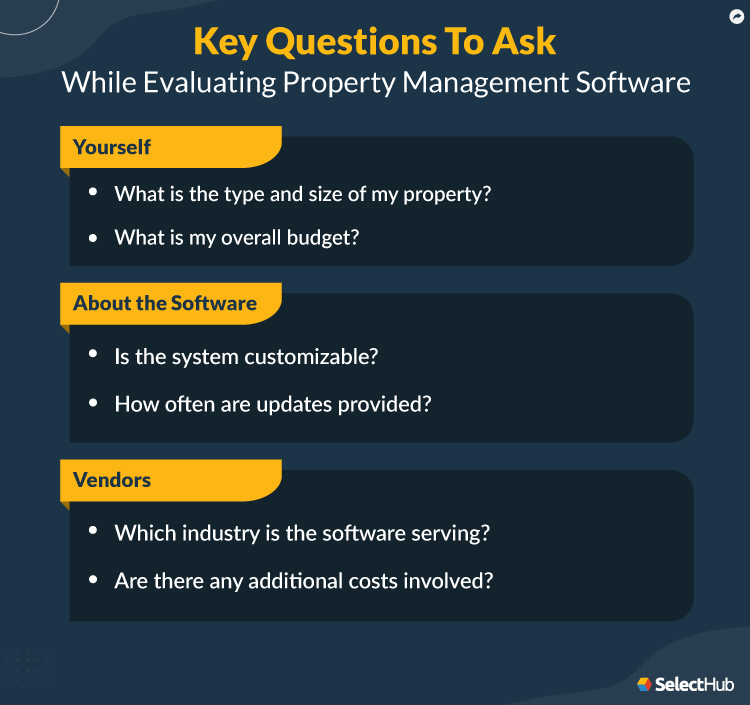
You can also jumpstart your selection process with our free property management software requirements template. Once you have a clear idea of your requirements, refer to the questions list below to ask yourself and any potential vendors to find the right solution that best aligns with your business.
Cost & Pricing Considerations
Generally, most property management software products are priced on a per unit, per month basis. Before investing in a platform, look out for a suitable deployment option. You can go through the details mentioned above and evaluate the pros and cons of on-premise and cloud-based deployments to shortlist one that suits your business size and budget.
You can consider vendors offering subscriptions, upgrades, training resources and support options. There may be additional or hidden costs involved, so it is advisable to cross-check all associated charges before purchasing.
If you are looking to upgrade, search for solutions that can integrate with your existing tools like CRM, accounting, marketing and more. This way, you can transfer data across applications conveniently and avoid data reentries.
It is evident that there is no standard guide to address the question of property management software pricing. You must gauge multiple factors and, most importantly, your company’s budget before investing in the right system. To simplify the process, you can consider using our free property management software comparison platform to compare top vendors based on features, pricing and other user-defined criteria.
Questions To Ask Yourself
Use these questions as a starting point for internal conversations:
- What is the type and size of my property?
- What is the overall budget?
- What goals do I want to accomplish?
- Do I need on-premise or cloud-based deployment?
- What features are required?
Questions To Ask Vendors
Use these questions as a starting point for conversations with vendors:
About the Software
- Is the system customizable?
- How often are the updates provided?
- Does it include training and support options?
- Does it offer mobile capabilities?
- Is the solution scalable?
About the Vendor
- Which industry is the software serving?
- Are there any additional costs involved?
- Does the vendor offer demos or free trials?
- Is there any implementation support provided?
- What programs integrate with your product?
Last Words
Every property management software offers a unique set of tools and features. Investing in a suitable product can help you become organized, increase efficiency and garner profits. This buyer’s guide intends to serve as a starting point to direct concerned professionals towards making an informed decision to find the top solution that helps meet targets and adds value to their enterprise.