Self-storage Software is All About Streamlining Management of Short-term Rental Storage Spaces By Riddhiman Roy, Market Analyst at SelectHub

Self-storage units are unique asset classes in commercial real estate with short-term leases. The continuous ebb and flow of tenants coupled with the post-pandemic environment make self-storage management quite a strenuous task. Self storage software saves the day by digitizing every customer interaction using online payments, eSignatures, chat portals and digital keys. You can manage, maintain and run individual units or site-wide facilities from a single platform and offer customers a contactless experience.
This guide covers the benefits of self-storage software, its key features, how to compare products, pricing considerations and more. Let’s dive in.
Executive Summary
- Self storage software enables you to automate administrative tasks and manage operations anywhere.
- It lets you track facility status, accept online rent, record entry and exit, communicate with tenants, and store leases.
- Identify your requirements and prepare a budget before starting the selection process to sift through various options available.
What This Guide Covers: Primary Benefits
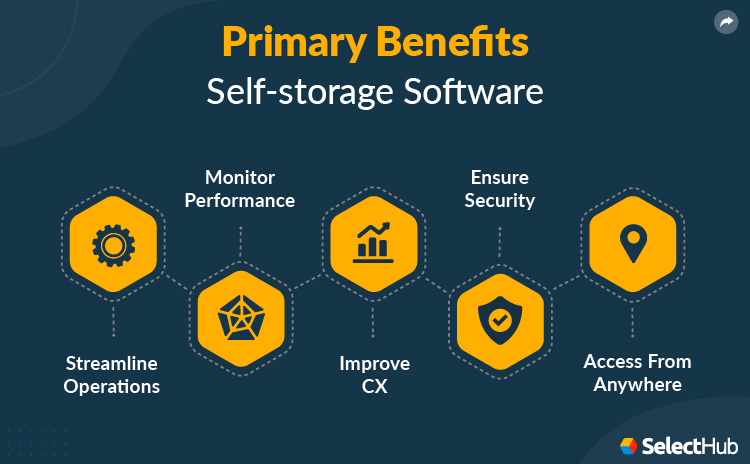
Streamline Operations
You can automate time-consuming tasks like rent collection, application processes, rent reminders, preventive maintenance and more.
Using template libraries, you can generate leases, rent agreements, auction letters and reports with a few clicks. The platform centralizes every administrative task under one roof for easy traceability, enabling you to focus on business scaling.
Monitor Performance
Advanced self-storage solutions usually come with built-in business intelligence. You can track personalized KPIs, generate profitability reports and identify opportunities to scale your business.
Improve Customer Experience (CX)
You can offer customers a self-guided booking experience and allow them to review units with an interactive facility map.
Platforms with tenant portals enable tenants to check dues, pay rent, renew leases, store documents and interact with managers. They can also submit maintenance requests with multimedia proof.
Ensure Security
You can set passcodes, video surveillance and other security measures and track them from a unified dashboard. Automate delinquency and lease termination based on custom rules.
Access From Anywhere
Stay on top of your operations from any remote location with the mobile-optimized platform.
Advanced solutions offer mobile apps to help book units, locate the nearest available space and send payments.
Basic Features & Functionality
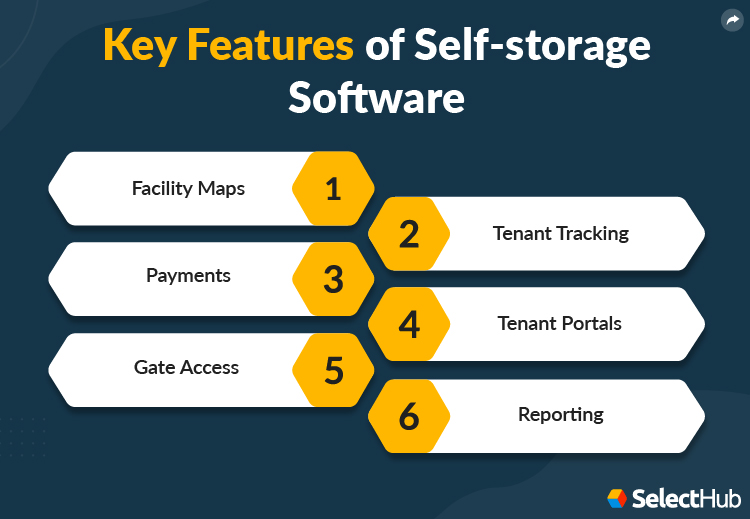
| Interactive Facility Maps | Color-coded maps show the status of each storage space at a glance. You can use the integrated map to assign maintenance activities, authorize access and schedule payments. |
| Tenant Tracking | Trace tenant activities like facility entry, payment history, past leases and more. Create a central repository of all your customer information and align your team on a single source of truth. |
| Payments | Accept rent and deposits via credit cards, ACH and digital wallets. Specify rules for sending automated reminders and block delinquent tenants. |
| Tenant Portals | You can provide tenants with unique portals to check storage status, assign entries, renew leases, pay rent and chat with managers. |
| Gate Access | Integrate the platform with your gate access system and give tenants unique codes for access to the compound. You can track movement, grant special permissions and block units (in case of discrepancies). |
| Reporting | The depth of the reporting suite varies from software to software. Most solutions offer profitability report templates, and advanced platforms provide real-time reporting, analysis and suggestions. |
Software Comparison Strategy
The global self-storage software market is forecasted to grow from $3.12 billion in 2021 to $6.43 billion in 2030, at a CAGR of 8.37%. Due to this growth, the market has various options available and picking the best one for your business can be tricky.
We recommend consulting your team members and preparing a personalized requirements checklist and budget before starting your selection process. It helps narrow down the options to a handful of ideal platforms.
Here are a few pointers you should consider while devising your requirements checklist:
-
Type of Portfolio: Identify the type of properties in your portfolio and look for software that can handle all of them. For example, most systems can manage drive-in storage units, but you’ve to look for solutions that can connect with thermostats for managing specialized properties with climate control.
- Integrations: The platform should connect with your existing software stack for smooth data transitions and workflows. We also advise making a list of potential systems you might use in the future. A few useful integrations include CRM, ERP, BI, accounting and more.
-
Team Members: Not every software offers unlimited onboarding, so keep an eye out for the number of team members you can onboard.
Once you have a clear idea of your requirements, use the above features table to identify basic and advanced features you need and look for software with those particular feature sets.
Cost & Pricing Considerations
Most self-storage solutions are cloud-based and available as SaaS. The vendors charge on a per unit, per month basis. Prices start at around $20 a month and can go upwards to $100 per month.
Some vendors can charge you extra for:
- Adding team members
- Onboarding and implementation support
- Priority support
- Advanced features
- Integrations
You can also try free self-storage software like 6Storage, CCStorage and Storanger. These platforms offer facility maps, online payment, revenue tracking and gate system integrations. Move onto paid plans for advanced features while scaling your business.
Questions To Ask
It’s crucial to ask the right questions while purchasing software. Use these questions to get the conversation rolling within your team and identify personal requirements:
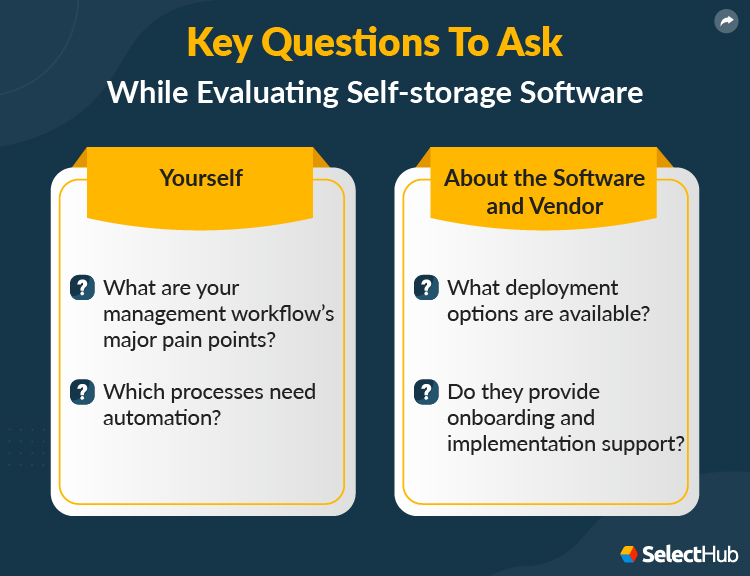
- What are your management workflow’s major pain points?
- Which processes need automation?
- What’s your budget for the product and advanced features?
- What’s your marketing strategy? Do you need a professional website?
- What’s your preferred payment mode?
- How diverse is your portfolio?
- What level of reporting do you require?
- Which other platform needs integration with your self-storage software?
Use these questions to start conversations with the vendors:
- Can you customize the solution?
- What deployment options are available?
- What’s the pricing structure? Are there any additional costs involved?
- Do they provide onboarding and implementation support?
- What are the training and support options?
- How often do they update the platform?
- What type of integrations are available?
FAQs
What Are the Types of Self-storage Facilities?
Not all items need the same type of storage. There are different types of self-storage properties available based on the user’s requirements, including:
-
Drive-up: This is one of the most common storage facilities that offers a row of small spaces accessible through drive-ins. It requires cameras, security and coded gates.
-
Climate Controlled: Used for storing fragile goods and paperwork that need protection against the impact of climatic changes. It usually comes with state-of-the-art thermostats to control temperature, humidity and more.
-
Heavy Equipment: These facilities can store factory machinery, cars, boats, RVs and other heavy equipment. They provide climate controls, 24x7 surveillance and digital keys. Some also offer transportation rentals for moving the cargo.
-
Mixed-use: It’s a modern approach that combines self-storage with retail and residentials to get approvals from local municipalities. For example, a self-storage unit with a live-in apartment or a storage compound with retail stores on the front.
Is It Worth Investing in Self-storage Properties Now?
There couldn’t have been a better time to invest in self-storage properties. With the pandemic, more and more urban dwellers are shifting towards the metropolitan outskirts. Reports show that more than one in 10 Americans moved in the first half of 2021 alone, and there were 36 million address changes.
As people move, they need space to store their belongings that otherwise won’t fit in their downsized country homes. This is where self-storage units come into the picture.
The global self-storage market is growing, and experts are optimistic that it will continue to grow exponentially in 2022, according to the latest report.
“The reasons for optimism include the expansion of the traditional ‘4Ds’ of self storage demand: death, divorce, dislocation and disaster,” the report mentioned. “Self storage executives are seeing robust demand not only from traditional drivers but from two additional Ds: decluttering and distribution/business demand.”
What Are the Relevant Industry Trends?
The self-storage industry is going through a boom and will witness many exciting technological advances. Some of the upcoming trends are:
- Robotics: Robotics is revolutionizing all industries, and self-storage is no exception. French engineering company, Wyca, has designed a robot, Elodie, that acts as a tour guide and point-of-sale system for prospects and tenants. You can conduct tours from your home and ensure social distancing.
-
Biometrics: Safety is a crucial factor in storage spaces. Biometric technology can guarantee secure compounds by using fingerprints, retina, voice and other unique characteristics to authorize access and prevent breaches.
-
Self-service Kiosks: This technology allows tenants to access the facility 24x7 without assistance from on-ground staff and physical interactions. You can track every tenant action from a dashboard.
In Conclusion
Managing a self-storage facility is hard already, so picking a self-storage software doesn’t have to be complicated. It’s like making that perfect subway sandwich: there are many options, but you identify your needs and build the ideal stack. Hopefully, this guide will help concerned professionals make an informed decision. Happy selecting!