Rental Property Management Software is All About Digitizing Rental Business Processes By Riddhiman Roy, Market Analyst at SelectHub

Gone are the days when it was necessary to run around collecting late rent payments, drown in paperwork, manually record interactions and regret renting to rogue tenants. Luckily, you can now consolidate every leasing, screening, management and accounting workflow under one roof with rental property management software. It allows rental managers to automate, streamline and monitor daily operations to sustain and scale businesses.
With multiple options available in the market, choosing the best fit for your business can be a tedious task. This guide aims to expedite your selection process and help you find a suitable solution based on your needs. It covers an overview of the software, followed by its deployment options, benefits and implementation goals. Finally, it will list basic and advanced features and some popular options to provide a starting point for your selection process. Let’s begin.
Executive Summary
- Rental property management software helps localize workflows, streamline communications, expedite turnover cycles and optimize marketing efforts.
- It offers basic features like document handling, eLeasing, tenant screening, payment processing, communication portals, maintenance management, accounting and reporting. Some of the advanced features include marketing suites, embedded business intelligence and more.
- The global pandemic significantly impacted the real estate industry, but a huge demand for rentals is incoming as the economy recuperates.
- Rental property management software pricing varies greatly. So we recommend preparing a budget and requirements checklist before sifting through the options.
- Making a list of questions to ask yourself and vendors can help narrow down your choices.
What This Guide Covers
Deployment Methods
Based on your business model and portfolio size, you can choose between on-premise or cloud-based deployment options:
On-Premise
For enterprise-level businesses with proper IT infrastructure already in place, choosing an on-premise deployment model makes a lot of sense. It offers in-depth customization capabilities and absolute control over business data and privacy. Also, on-premise solutions don’t rely on an internet connection.
On-premise systems require you to buy software or licenses and install the setup on proprietary servers. The expenditure on hardware, maintenance, hiring IT professionals and upgrading software add to the hidden costs, making it an expensive investment with a higher cost of entry. However, it’s cost-effective in the long run as businesses can avoid additional subscription costs while scaling operations.
Cloud-Based
With a cloud-based model, you can securely host the software package and associated data on vendors’ servers and access it through any device using a stable internet connection. It’s an economical option that doesn’t require costly maintenance and upgrades, expensive infrastructure, and IT professionals. It bundles all services and functionalities in one package and allows access through a subscription fee.
But every rose has its thorns. With an external vendor handling your data, you require extra scrutiny and vigilance to counter unauthorized access and territorial breaches. Additionally, the cloud-based option lacks customization capabilities and provides external businesses with a stake in your operations. Meaning disruptions in the vendor’s operations may reflect on your workflow.
The best deployment type depends on your portfolio size, business needs and available infrastructure and personnel. Growing businesses with limited resources might prefer an all-inclusive cloud deployment model, whereas big companies with existing infrastructure and personnel can opt for an on-premise setup. But these rules aren’t fixed, and it’s crucial to determine your unique business requirements before selecting a deployment option.
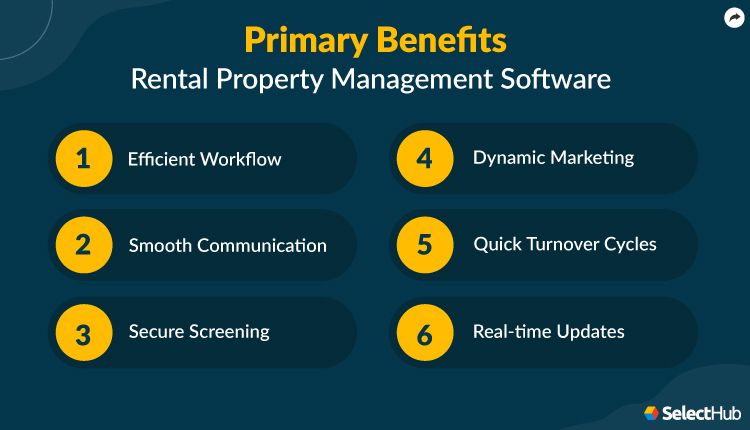
Primary Benefits
Efficient Workflow
You can consolidate all transactional, marketing, leasing, accounting and management workflows in a single location. Automate rent collections, reminders, bookkeeping, tenant screening, vacancy listings and more.
Reducing the administrative legwork allows you to gather and analyze organizational data and focus on managing and scaling the business. It helps ensure accuracy, standardization and better maintenance of documents and records.
Streamlined Communications
Every business must know its customers’ wants and desires to become successful. A rental property management solution provides a standard interface for tenants to interact with owners and managers. Tenants can use the portal to submit documents, raise issues and send maintenance requests. You can send reminders and notices and perform virtual property inspections.
Most solutions provide a mobile app for remote interactions, and some even offer external maintenance vendors a separate portal to perform and log recurring tasks. Also, record every interaction to maintain a clean audit trail.
Secure Screening
Finding a suitable tenant is always big on any landlord or rental manager’s agenda. The software streamlines the screening process by helping managers check every prospect’s credit score, eviction history, criminal background and more from a dashboard. Set personalized parameters and automate the screening of interested tenants.
Some solutions come with a rent-to-income ratio calculator to eliminate unqualified applicants. Most systems partner with or consult TransUnion’s resident score and credit reports for screening and provide an option to charge an application fee.
Real-Time Updates
A rental property management platform provides a hawkeye view of business processes, allowing you to stay on top of every volatility and adjust operations according to conditions. It alerts owners about pending tax and insurance payments and document renewals to ensure compliance with federal regulations and standards.
Dynamic Marketing
Rental property management software usually comes with a native channel manager, enabling you to list properties across various listing channels and manage every listing from a unified platform. Consolidating marketing efforts for every channel promotes accuracy, consistency and increased engagement per listing.
Some solutions offer personalized websites branded with business logos and colors to increase portfolio visibility online. A few systems provide digital content services to help you develop interactive and innovative multimedia content like 3D tours, drone videos and copy editing to enhance property listings.
Quick Turnover Cycles
Expedite the leasing cycle by automating major processes like screening prospects and receiving online applications. You can shorten turnover periods with timely rent clearance, utility bill payments and updated maintenance activities that allow renters to move in or out quickly. Keep properties ready for renting to generate more revenue, boosting overall ROI.
Implementation Goals
In order to find the right solution, it’s important to recognize and list fundamental goals you wish to achieve through a rental property management system. We’ve modeled a few implementation goals to help you start identifying your objectives:
| Goal 1
Improved Efficiency
|
A rental management solution can help you ensure accuracy and consistency, reduce administrative tasks, eliminate human errors, and focus on problem-solving.
It serves as a central repository of property documents and business interactions, enabling data analysis from one location.
|
| Goal 2
Increased Flexibility
|
You can manage operations remotely by monitoring workflows, accessing essential documents and interacting with team members and tenants from anywhere. Easily add or subtract properties from your portfolio while scaling your business.
|
| Goal 3
Connected Software Stack
|
Rental management software is not a standalone solution and integrates with backend systems to deliver various functionalities. It’s built on a flexible API to allow easy integrations with your current software stack like CRM, ERP or CMS and provide room for future upgrades.
|
Basic Features & Functionality
There are a lot of rental property management solutions available with a unique set of features and selling points. We’ve listed some of the bare-bone features that your rental management system must have to succeed:
| Document Management |
You can leverage template libraries to create personalized documents like leases, notices, invoices and receipts. Send eLeases to prospective tenants and allow them to sign from any remote location digitally.
Store unlimited documents and monitor their privacy settings. Managers can send property-specific files and reports to owners.
|
| Tenant Screening |
It allows you to check every prospect’s credit, criminal and eviction history through direct connection with TransUnion or paid screenings.
Collect screening fees from candidates during the application process and set personalized parameters like minimum income, marital status, age group and more to find ideal tenants.
|
| Payment Processor |
Some solutions come with a native payment processor partnered with local and national banks like Entrata, Buildium and Rentec Direct. In contrast, others allow integration with popular digital wallets like PayPal, Stripe and Venmo to process transactions.
Accept credit and debit cards and ACH transfers while allowing tenants to set up recurring rent and utility bills. Charge late rent penalties and create tenant insurance programs.
|
| Property Management |
You can receive maintenance requests and assign vendors or staff for each task. Monitor progress from a dashboard, automate invoice payments and maintain a record of every vendor assigned to maintain a clean audit trail.
Manage and track energy consumption and simplify utility management by automating the billing and collection process. A few solutions like RealPage offer a submetering feature to allocate utility bills to every renter based on actual consumption.
|
| Communication Portals |
Keep managers, owners, vendors and renters on the same page with a unified platform for interactions. Send texts and multimedia elements using templates to design emails.
Tenant portals allow residents to pay rent and ancillary charges, submit maintenance requests with photos, track progress and receive notifications for guests and delivery parcels. At the same time, owner portals let owners track property performance, occupancy rates and cash flows and download property-specific statements.
|
| Accounting |
Automate bookkeeping, record company financials in real time and maintain general ledgers while keeping track of bills and discrepancies.
Most solutions support electronic 1099-S tax form filings and offer integrations with QuickBooks or other accounting software for in-depth snapshots of the company’s financial status.
|
| Reporting |
You can access a customizable report templates library to build unique financial reports, helping identify new opportunities.
Optimize prices by drilling down on critical areas to maximize profitability. Most solutions let you export reports in PDF or Excel formats.
|
Advanced Features & Functionality
| CRM |
Store all customer data in a central repository and enable users to respond to feedback and reviews from a dashboard. Some solutions like Propertyware and AppFolio offer a 24/7 call center service where agents are equipped with users’ portfolio details to receive sales, leasing and maintenance calls.
Agents can answer custom queries, schedule tours, dispatch pre-approved vendors and automate data input to the repository.
|
| Embedded Intelligence |
Streamline tenant screening through AI and leverage machine learning with behavioral data to detect fraudulent prospects. You can simplify property maintenance by automatically choosing the best-rated local vendors and assigning maintenance tasks to them.
Some solutions also offer AI as an optional module to analyze business data and dig out actionable insights.
|
| Rent Analysis |
A pretty useful feature, albeit optional, lets you analyze the rent structure of neighboring and local rental properties to quote optimal rent to prospective tenants using AI and machine learning capabilities.
|
Current & Upcoming Trends
The pandemic caused the apartment rental demand to drop significantly, leading to decreased income and outflow of investor money. But is it all doom and gloom for the rental industry? Certainly not. 2020 was challenging but unearthed many new opportunities and avenues with the rental industry gradually adapting to societal digitalization.
Surge in Rental Demand
During the pandemic, people were fleeing to suburbs due to more space, absence of large crowds and lower rent structures, affecting the rental market. But as the government started acknowledging and protecting tenant wellbeing, the market showed signs of recovery.
In Manhattan, more apartments were rented in the third quarter than at any other time in the last 32 years. Other prominent cities are not far behind as the economy recovers, unemployment decreases and discretionary income rises en masse.
Demographic Shifts
The property management industry has been dealing with Millenials for many years. But now, the youngest Millennials (24 years old) and Gen Z (students, freshers and bachelors) are showing interest in the rental industry. A significant challenge for the industry would be to adapt to this shift and satisfy the diverse housing demands of both generations.
Technology would be at the core of this revamping as the upcoming generation is highly tech-savvy. 77% of renters want to pay rent online, 64% prefer digital interactions and 77% look for rentals online before physical searches in the neighborhood, according to a renters’ report.
Government Regulations
COVID-19 forced governments worldwide to take drastic preventive measures to protect tenants during a period of turmoil and unemployment. Although the Supreme Court withdrew the national ban on eviction in the U.S., some major states like Washington, D.C. and California still refuse to evict renters from their homes, making it tough for managers and owners to maintain profitability. As the market recovers in 2021, the demand for apartment rentals will rise, but it’ll be interesting to see what happens when market regulations tighten and drive urban rental prices up.
Other government regulations like reducing the number of viewings and carrying them out with pre-screening processes have led to the rise of innovative solutions that allow virtual tours, 360° video tours and more. These new avenues will add to the existing rental management solutions, further enhancing the customer experience.
Smart Homes
At first glance, a smart home might seem like a luxury, but upon closer inspection, we see that it helps attract and retain tenants, allowing managers and owners to increase rent and profits. Rentals with smart locks enable managers to handle property access remotely. Intelligent sensors and thermostats avoid extreme usage of HVAC systems, leading to predictable utility bills each month. Synced digital calendars allow you to schedule agent-free virtual property tours.
On top of that, there’s a higher chance of engaging Gen Z tenants in your rental if you provide amenities like voice assistants, smart lights, smart doors and other technologies.
The Era of Digital Marketing
In this digital age, it has become convenient to look for rentals on property listing websites over physical hunts. With limited open house tours, real estate agents are coming up with unique and innovative methods for property tours. Virtual tours, email marketing, social media and content marketing are some of the exciting trends to look for in 2022 that will change how managers generate leads..
Many solutions offer digital asset management suites, and some provide specialists to outsource and create video tours, property photographs, drone footage, virtual 3D models and more.
With the industry increasingly adapting to this change, the onus will be on the quality of digital content uploaded to help beat competitors and attract suitable tenants.
Software Comparison Strategy
With many options available in the market, we can’t simply point you to a fit-for-all solution. What might work for one business might not work for you. To find suitable software, it’s essential to list all your requirements, necessary features and implementation goals and start striking out the solutions not providing them.
It’s also important to determine what type of buyer you are and how big your business is before singling out the right software:
- Property owners (1-9 units) can use any basic solution to ensure accuracy, standardization and better maintenance of records and documents. They should avoid expensive solutions with in-depth features.
- Owners and property managers (10+units) can choose systems that help monitor and manage property workflows from a centralized dashboard.
- Property management companies and enterprises should go for a robust solution that allows the onboarding of unlimited team members and properties. A solution built on a flexible API can allow easy integrations with the existing software stack.
Once you finish compiling your personalized requirements list, you can refer to the questions mentioned below to start asking yourself and vendors the right questions to find a perfect solution.
Cost & Pricing Considerations
The pricing of rental management software primarily depends on the number of properties you want to manage and the advanced features you desire. Some vendors offer subscription-based pricing, while others provide perpetual licenses based on the deployment option.
We recommend fixing a budget before starting the selection process. Otherwise, it might get dizzying with the vast number of variants available.
Additionally, there might be extra charges for onboarding, data migration and implementation. Some vendors also charge extra for a marketing suite or professional website, so it’s imperative to have a detailed requirements list. Intricately weigh in on required features versus available budget to shortlist ideal solutions for your business.
Questions To Ask Yourself
Use these questions as a starting point for internal conversations:
- What’s your deployment strategy?
- What type of property are you renting — residential, commercial or community housing?
- Would you require multi-location property management capabilities?
- What level of reportage does your business demand?
- What nuanced features do you desire?
- What’s your overall budget — for software and additional features?
- Which existing software would need integration with your new rental property management software?
Questions To Ask Vendors
Use these questions as a starting point for conversations with vendors:
About the Software
- Does the software provide all essential functionalities?
- Can it handle your entire property portfolio?
- Is there a mobile app available?
- Will it provide adequate marketing capabilities that align with business growth?
- Is it built on a flexible programming interface for easy integrations?
- What are the paid features, and will they help your business?
- Is the solution scalable?
About the Vendor
- Is the company growing or established in the market?
- What are the technical support options available?
- Is there a comprehensive onboarding and training process?
- What’s the response time of the vendor support team?
- Is there any third-party periodical auditing for the vendor’s stored customer data?
- Are there any unique partnerships that add value to the software?
In Conclusion
Each software has its own set of functionalities and target audience. Investing in the right solution can not only help you streamline work processes but also gain valuable clarity into business operations. You can use rental property management software to scale your business, better communicate with renters and guarantee consistency across all channels. Hopefully, this buyer’s guide can point concerned professionals towards an ideal solution that adds value to their organization.